
Diagnosis
Due to its rarity and heterogenous clinical presentations, the diagnosis of lipodystrophy may be missed as most clinicians are not familiar with its diagnosis and management.1
- How can I detect lipodydstrophy
- What are the different forms of lipodydstrophy?
- Clinical characteristics of lipodydstrophy
- Differential Diagnosis
How can I detect Lipodystrophy?
Generalised and partial lipodystrophy may be hard to
detect. If you suspect your patient to have lipodystrophy,
several tools can assist you in determining a diagnosis.
Download the LipoDDx App
that can help in the diagnosis
of lipodystrophy


What are the different forms of
Lipodystrophy?
Lipodystrophies are potentially life threatening diseases,
heterogeneous in appearance, very rare, and characterised by a partial
or complete loss of subcutaneous fatty tissue. Symptoms manifest
differently in each patient and not all of these symptoms have to occur
in all patients.
The disease is subdivided according to four primary categories:
CGL, AGL, FPLD and APL.
Lipodystrophy is heterogenous in appearance – but it is always linked to a lack of subcutaneous adipose tissue.
Lipodystrophy is considered as a visual diagnosis, therefore the patient
must be examined unclothed. However, in addition to the unusual
appearance of a lipodystrophy patient, there are also other
conspicuous clinical symptoms.
For an overview of the clinical features for the different lipodystrophy subtypes please click the image

Clinical characteristics of Lipodystrophy

GENERALISED LIPODYSTROPHY
- Generalised absence of subcutaneous adipose tissue1-9
- Resulting deficiency in the hormone leptin1-6
- Metabolic abnormalities including1-6
- Insulin resistance
- Diabetes mellitus
- Hypertriglyceridemia
- Ectopic fat deposition in the liver, muscle, and other organs which may cause serious organ damage1-6
- Estimated prevalence 0.23-0.96 in 1,000,000 population7
- May be Congenital – from birth or Acquired – usually presenting
in childhood or adolescence1-5, 8,9
Congenital

Characteristics of Congenital Generalised Lipodystrophy1-5
Age of onset: Apparent at birth or early childhood
Male : Female ratio: 1 : 1 – 2
Essential characteristics:
- Autosomal recessive (AR) inheritance in vast majority of cases,
- Family history or consanguinity may present
- Near-complete lack of adipose tissue
Possible clinical features of Congenital Generalised Lipodystrophy1-5,8
Not all of these features may be present in all patients:
- Hyperphagia
- Prominent muscles and veins
- Hepatosplenomegaly
- Hyperlipidemia
- Acanthosis nigricans, signs of insulin resistance, diabetes
- Hyperandrogenism in females
- Acromegaloid features
- Advanced bone age
- Accelerated growth
Acquired

Characteristics of Acquired Generalised Lipodystrophy1-5,8-9
Age of onset: Variable, usually in childhood or adolescence
Male : Female ratio: 1 : 3
Essential characteristics:
- Progressive loss of fat leading to near-complete lack of adipose tissue
- No family history
- Associated with autoimmune illness e.g. juvenile dermatomyositis, autoimmune hepatitis, type 1 diabetes or panniculitis
Possible clinical features of Acquired Generalised Lipodystrophy1-5,8-9
Not all of these features may be present in all patients:
- Variable fat loss pattern (e.g. preserved intra-abdominal fat in some cases)
- Hyperphagia
- Prominent muscles and veins
- Hepatosplenomegaly
- Hyperlipidemia
- Acanthosis nigricans, signs of insulin resistance, diabetes
- Hyperandrogenism in females
PARTIAL LIPODYSTROPHY
- Partial absence of subcutaneous adipose tissue1-9
- Accumulation of fat in other parts of the body in some patients1-5
- Metabolic abnormalities including1-5
- Insulin resistance
- Diabetes mellitus
- Hypertriglyceridemia
- Ectopic fat deposition in the liver, muscle, and other organs which may
cause serious organ damage1-5 - Estimated prevalence 1.67 in 1,000,000 population7
- May be familial or aquired1-5, 8
Familial

Characteristics of Familial Partial Lipodystrophy1-5
Age of onset: Around puberty
Male : Female ratio: 1 : 4 – 5
Essential characteristics:
- Regional loss of adipose tissue.
- Fat accumulation may present resembling obesity or Cushing’s Syndrome
- May present with hyperphagia
- Variable degree of metabolic abnormalities
Possible clinical features of Familial Partial Lipodystrophy (FPLD)1-5
FPLD more likely to present with:
- Hyperphagia
- Prominent muscles and veins
- Acanthosis nigricans, signs of insulin resistance
- Hyperandrogenism in females
*Not all of these features may be present in all patients
Acquired

Characteristics of Acquired Partial Lipodystrophy1-5,8,9
Age of onset: Child, adolescence or early adulthood
Male : Female ratio: 1 : 4
Essential characteristics:
- Gradual loss of adipose tissue from head downwards
- Fat can accumulate around the hips, buttocks, and legs in some patients
- Metabolic abnormalities less common, but can vary in severity
Possible clinical features of Acquired Partial Lipodystrophy (APL)1-5,8,9
APLD more likely to present with:
- No fat loss from lower extremities
- Mild or no metabolic complications (but these may still be found)
*Not all of these features may be present in all patients

Differential Diagnosis
The path to diagnosis can be difficult and long. According to the subtype, onset of lipodystrophy symptoms may occur between infancy and adolescence.
Health complications associated with the disease can vary greatly. In particular, patients suffering from partial lipodystrophy do not necessarily display any symptoms until puberty.
Special attention should be paid to FPLD as this might be confused with truncal obesity, Cushing’s syndrome and multiple symmetric lipomatosis.
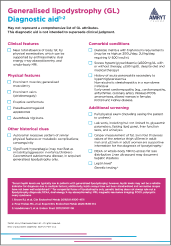
Differential diagnosis of generalized lipodystrophy (GL)
Generalized Lipodystrophy
Key clinical features:
Near total fat loss, subtype specific features
Metabolic abnormalities:
Yes; may be absent in the early years of life
Appetite:
Increased
Adiponectin:
Low
Additional work-up:
Imaging, genetic testing, etc.
Adrenal insufficiency21,22
21,22
Key clinical features:
Symptoms of adrenal insufficiency
Metabolic abnormalities:
Hypoglycemia
Appetite:
Decreased
Adiponectin:
Normal in Addison’s disease, slightly low in SAI
Additional work-up:
Cortisol, ACTH, dynamic tests to evaluate the adrenal gland functions and HPA axis
Poorly controlled type 1 diabetes mellitus26-28
Key clinical features:
Insulin deficient diabetes
Metabolic abnormalities:
Hyperglycemia, ketoacidosis; hypertriglyceridemia possible
Appetite:
Variable
Adiponectin:
High
Additional work-up:
C-peptide, AntiGAD antibody
Diencephalic syndrome35
35
Key clinical features:
Headaches, abnormal progressive thinness and weakness, vomiting, vision abnormalities, nystagmus
Metabolic abnormalities:
Failure to gain weight and grow; hypoglycemia in some patients
Appetite:
Variable
Adiponectin:
Not studied
Additional work-up:
Imaging of tumor located in the diencephalon
Malnutrition/starvation11, Anorexia nervosa12, Tumor induced cachexia13, Severe chronic inflammation14,15
11,12,13,14,15
Key clinical features:
Poor growth in children with malnutrition, distorted body image in anorexia nervosa, elevated acute phase reactants in severe chronic inflammation
Metabolic abnormalities:
Hypoglycemia rather than hyperglycemia possible; glycogen deposition with elevated LFTs can be seen
Appetite:
Variable
Adiponectin:
Elevated
Additional work-up:
Albumin, or prealbumin, micronutrient levels; psychiatric counseling; tumor markers and imaging; work-up to diagnose chronic inflammatory diseases
HIV-associated wasting23,24
23,24
Key clinical features:
Chronic diarrhea and malabsorption, cytokine response to virus, hypogonadism, increased resting energy expenditure
Metabolic abnormalities:
Variable; insulin resistance; hypertriglyceridemia can be seen (at least partly associated with HIV treatment)
Appetite:
Decreased
Adiponectin:
Low
Additional work-up:
HIV Panel
Glycogenic hepatopathy29
Key clinical features:
Poorly controlled diabetes, hepatomegaly, elevated liver enzymes (usually higher than typical levels for NASH)
Metabolic abnormalities:
Ketoacidosis; most patients have type 1 diabetes; rarely reported in type 2 diabetes
Appetite:
Variable
Adiponectin:
Not studied, more likely elevated
Additional work-up:
Liver biopsy
Thyrotoxicosis16-20
Key clinical features:
Symptoms of thyrotoxicosis
Metabolic abnormalities:
Mild hyperglycemia/insulin resistance; triglycerides usually normal; elevated LFTs possible
Appetite:
Normal/Increased
Adiponectin:
Normal
Additional work-up:
Thyroid functions
Insulin receptor mutations (INSR)25
Key clinical features:
Extreme insulin resistance, hyperandrogenism in females, prepubertal linear growth acceleration, pseudoacromegaly
Metabolic abnormalities:
Extreme hyperinsulinemia but normal lipid profile; relative lack of fatty liver; acanthosis nigricans
Appetite:
Normal/Increased
Adiponectin:
Very high
Additional work-up:
Elevated SHBG and IGFBP1
Acromegaly/gigantism30-34
30-34
Key clinical features:
Symptoms of acromegaly, no actual generalized fat loss
Metabolic abnormalities:
Yes; but usually moderate (unless there is a preexisting underlying metabolic disorder)
Appetite:
Usually increased
Adiponectin:
Low
Additional work-up:
IGF-1, GH, OGTT
ACTH, Adrenocorticotropic hormone; GH, Growth hormone; GAD, Glutamic acid decarboxylase; HIV, Human immunodeficiency virus; HPA, Hypothalamic-pituitary-adrenal; IGF, Insulin growth factor; IGFBP1, IGF binding protein- 1; LFTs, Liver function tests; NASH, Nonalcoholic steatohepatitis; OGTT, Oral glucose tolerance test; SAI, Secondary adrenal insufficiency; SHBG, Sex Hormone Binding Globulin.
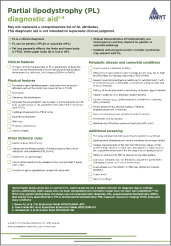
Differential diagnosis of generalized lipodystrophy (PL)
FPLD36,37
36,37
Family History:
Likely
Key clinical features:
Loss of fat in the limbs predominantly affecting the lower part of the body Increased fat in face, neck and genital area (FPLD2)
Metabolic abnormalities:
Yes. Heart disease (structural, ischemic or arrhythmogenic disorders reported)
Leptin:
Normal or low
Adiponectin:
Normal or low, but lower than truncal obesity
Additional work-up:
DEXA and/or MRI Anthropometric measurements Genetic testing
Barraquer-Simons43,44
43,44
Family History:
No
Key clinical features:
Central obesity
Metabolic abnormalities:
Less frequent
Leptin:
Likely normal
Adiponectin:
Likely normal
Additional work-up:
Serum C3 complement Urinary protein excretion Retina exam
HIV-associated lipodystrophy51,52
51,52
Family History:
No
Key clinical features:
Fat redistribution, central obesity
Metabolic abnormalities:
Yes
Leptin:
Normal or high
Adiponectin:
Usually in the normal range
Additional work-up:
HIV test
Lymphocyte subpopulations
Cushing syndrome38,39
38,39
Family History:
No
Key clinical features:
Muscle weakness, stretch marks, central obesity, round face, buffalo hump, osteoporosis
Metabolic abnormalities:
Yes
Leptin:
Usually high, although conflicting reports are present
Adiponectin:
Normal or high, although conflicting reports are present
Additional work-up:
Serum cortisol levels Cortisol suppression test
Progeroid syndromes* 45,46
45,46
Family History:
Likely in some but most cases are de novo.
Key clinical features:
Progressive fat loss (GL or PL), progeroid features, cardiac abnormalities, renal involvement likely
Metabolic abnormalities:
Metabolic abnormalities develop later, and are usually progressive.
Leptin:
Usually low
Adiponectin:
Usually low
Additional work-up:
Genetic testing
Subtype specific work-up
Truncal obesity40-42
40-42
Family History:
Likely in some
Key clinical features:
Central obesity
Metabolic abnormalities:
Yes
Leptin:
Normal or high
Adiponectin:
Normal or low
Additional work-up:
Rule out secondary obesity
Myeloablative therapy induced lipodystrophy47-50
47-50
Family History:
No
Key clinical features:
Loss of fat in limbs and trunk, increased fat in face and neck (some cases)
Metabolic abnormalities:
Yes
Leptin:
Not reported
Adiponectin:
Not reported
Additional work-up:
Not specific
*Progeroid syndromes are their own category, but need to be separated from APL due to the development of fat loss later in life and FPLD due to genetic etiology.
Progeroid features include micrognathia, mottled skin, atrophic skin, beaked nose, thin lips and receding hairline, hair loss, skeletal abnormalities such as mandibular and clavicular hypoplasia, scoliosis, acroosteolysis, etc.
References
- Akinci B, Oral EA, Neidert A, et al. Comorbidities and Survival in Patients With Lipodystrophy: An International Chart Review Study. J Clin Endocrinol Metab. 2019;104(11):5120-5135.
- Garg A. 2011. JCEM, 96(11):3313-25.
- Oral EA. 2003. Rev Endocr Metab Discord, 4(1):61-77
- Gupta N, et al. 2017. JCEM, 102(2):363-374.
- Brown RJ, et al. 2016. JCEM,101(12):4500-4511.
- Handelsman Y, et al. 2013. Endocr Pract,19(1):107-16.
- Moon HS, et al. 2013. Endocr Rev, 34(3):377-412.
- Chiquette E, et al. 2017. Diabetes Metab Syndr Obes, 10 375–383
- Guillín-Amarelle C, et al. 2015. Med Clin (Barc), 144(2):80–87.
- Misra A, et al. 2003. Medicine, 82(2):129-46.
- Stofkova A. Leptin and adiponectin: from energy and metabolic dysbalance to inflammation and autoimmunity. Endocr Regul. 2009 Oct;43(4):157–168.
- Bosy-Westphal A, Brabant G, Haas V, et al. Determinants of plasma adiponectin levels in patients with anorexia nervosa examined before and after weight gain. Eur J Nutr. 2005 Sep;44(6):355–359.
- Smiechowska J, Utech A, Taffet G, et al. Adipokines in patients with cancer anorexia and cachexia. J Investig Med. 2010 Mar;58 (3):554–559.
- Ghigliotti G, Barisione C, Garibaldi S, et al. Adipose tissue immune response: novel triggers and consequences for chronic inflamma- tory conditions. Inflammation. 2014 Aug;37(4):1337–1353.
- Cildir G, Akincilar SC, Tergaonkar V. Chronic adipose tissue inflam- mation: all immune cells on the stage. Trends Mol Med. 2013 Aug;19(8):487–500.
- Vaidya B, Pearce SH. Diagnosis and management of thyrotoxicosis. BMJ. 2014 Aug 21;349(7):g5128.
- Kokkinos S, Papazoglou D, Zisimopoulos A, et al. Retinol binding protein-4 and adiponectin levels in thyroid overt and subclinical dysfunction. Exp Clin Endocrinol Diabetes. 2016 Feb;124(2):87–92.
- Ozdemir D, Dagdelen S, Usman A. Serum adiponectin levels and changes in glucose metabolism before and after treatment for thyroid dysfunction. Intern Med. 2015;54(15):1849–1857.
- Chen Y, Wu X, Wu R, et al. Changes in profile of lipids and adipokines in patients with newly diagnosed hypothyroidism and hyperthyroidism. Sci Rep. 2016 May;6(1):26174.
- Cinar N, Gurlek A. Association between novel adipocytokines adi- ponectin, vaspin, visfatin, and thyroid: an experimental and clinical update. Endocr Connect. 2013;2(4):R30–8.
- Hayashi R, Tamada D, Murata M, et al. Glucocorticoid replacement affects serum adiponectin levels and HDL-C in patients with sec- ondary adrenal insufficiency. J Clin Endocrinol Metab. 2019 Jul 10;104(12):5814-5822.
- Fichna M, Fichna P, Gryczynska M, et al. Steroid replacement in primary adrenal failure does not appear to affect circulating adipokines. Endocrine. 2015 Mar;48(2):677–685.
- Parfieniuk-Kowerda A, Czaban SL, Grzeszczuk A, et al. Assessment of serum IGF-1 and adipokines related to metabolic dysfunction in HIV-infected adults. Cytokine. 2013 Oct;64(1):97–102.
- Tsiodras S, Perelas A, Wanke C, et al. The HIV-1/HAART associated metabolic syndrome – novel adipokines, molecular associations and therapeutic implications. J Infect. 2010 Jul;61(2):101–113.
- Semple RK, Soos MA, Luan J, et al. Elevated plasma adiponectin in humans with genetically defective insulin receptors. J Clin Endocrinol Metab. 2006 Aug;91(8):3219–3223.
- Imagawa A, Funahashi T, Nakamura T, et al. Elevated serum con- centration of adipose-derived factor, adiponectin, in patients with type 1 diabetes. Diabetes Care. 2002 Sep;25(9):1665–1666.
- Lindstrom T, Frystyk J, Hedman CA, et al. Elevated circulating adiponectin in type 1 diabetes is associated with long diabetes duration. Clin Endocrinol (Oxf). 2006 Dec;65(6):776–782.
- Galler A, Gelbrich G, Kratzsch J, et al. Elevated serum levels of adiponectin in children, adolescents and young adults with type 1 diabetes and the impact of age, gender, body mass index and metabolic control: a longitudinal study. Eur J Endocrinol. 2007 Oct;157(4):481–489.
- Hamed AE, Elwan N, Naguib M, et al. Diabetes association with liver diseases: an overview for clinicians. Endocr Metab Immune Disord Drug Targets. 2019;19(3):274–280.
- Fukuda I, Hizuka N, Ishikawa Y, et al. Serum adiponectin levels in adult growth hormone deficiency and acromegaly. Growth Horm IGF Res. 2004 Dec;14(6):449–454.
- Gurbulak S, Akin F, Yerlikaya E, et al. Adiponectin and cardiac hypertrophy in acromegaly. Adv Clin Exp Med. 2016 May-Jun;25 (3):449–455.
- Silha JV, Krsek M, Hana V, et al. Perturbations in adiponectin, leptin and resistin levels in acromegaly: lack of correlation with insulin resistance. Clin Endocrinol (Oxf). 2003 Jun;58(6):736–742.
- Sucunza N, Barahona MJ, Resmini E, et al. A link between bone mineral density and serum adiponectin and visfatin levels in acromegaly. J Clin Endocrinol Metab. 2009 Oct;94(10):3889–3896.
- Lam KS, Xu A, Tan KC, et al. Serum adiponectin is reduced in acromegaly and normalized after correction of growth hormone excess. J Clin Endocrinol Metab. 2004 Nov;89(11):5448–5453.
- Satyarthee GD, Chipde H. Diencephalic syndrome as presentation of giant childhood craniopharyngioma: management review. J Pediatr Neurosci. 2018 Oct–Dec;13(4):383–387.
- Garg A, Agarwal AK. Lipodystrophies: disorders of adipose tissue biology. Biochim Biophys Acta. 2009 Jun;1791(6):507–513.
- Melvin A, O’Rahilly S, Savage DB. Genetic syndromes of severe insulin resistance. Curr Opin Genet Dev. 2018 Jun;50:60–67.
- Masuzaki H, Ogawa Y, Hosoda K, et al. Glucocorticoid regulation of leptin synthesis and secretion in humans: elevated plasma leptin levels in Cushing’s syndrome. J Clin Endocrinol Metab. 1997 Aug;82 (8):2542–2547.
- Babinska A, Kaszubowski M, Kmiec P, et al. Adipokine and cytokine levels in patients with adrenocortical cancer, subclinical Cushing’s syndrome and healthy controls. Steroids. 2018;140:39–44.
- Scherer PE. The many secret lives of adipocytes: implications for diabetes. Diabetologia. 2019 Feb;62(2):223–232.
- Stroescu RF, Marginean O, Bizerea T, et al. Adiponectin, leptin and high sensitivity C-reactive protein values in obese children – impor- tant markers for metabolic syndrome? J Pediatr Endocrinol Metab. 2019 Jan 28;32(1):27–31.
- Bueno AC, Sun K, Martins CS, et al. A novel ADIPOQ mutation (p. M40K) impairs assembly of high-molecular-weight adiponectin and is associated with early-onset obesity and metabolic syndrome. J Clin Endocrinol Metab. 2014 Apr;99(4):E683–93.
- Akinci B, Onay H, Demir T, et al. Clinical presentations, metabolic abnormalities and end-organ complications in patients with famil- ial partial lipodystrophy. Metabolism. 2017;72:109–119.
- Lightbourne M, Brown RJ. Genetics of lipodystrophy. Endocrinol Metab Clin North Am. 2017 Jun;46(2):539–554.
- Simha V, Garg A. Body fat distribution and metabolic derange- ments in patients with familial partial lipodystrophy associated with mandibuloacral dysplasia. J Clin Endocrinol Metab. 2002 Feb;87(2):776–785.
- Novelli G, Muchir A, Sangiuolo F, et al. Mandibuloacral dysplasia is caused by a mutation in LMNA-encoding lamin A/C. Am J Hum Genet. 2002 Aug;71(2):426–431.
- Patni N, Alves C, von Schnurbein J, et al. A novel syndrome of generalized lipodystrophy associated with pilocytic astrocytoma. J Clin Endocrinol Metab. 2015 Oct;100(10):3603–3606.
- Wei C, Thyagiarajan MS, Hunt LP, et al. Reduced insulin sensitivity in childhood survivors of haematopoietic stem cell transplantation is associated with lipodystropic and sarcopenic phenotypes. Pediatr Blood Cancer. 2015 Nov;62(11):1992–1999.
- Adachi M, Oto Y, Muroya K, et al. Partial lipodystrophy in patients who have undergone hematopoietic stem cell transplantation dur- ing childhood: an institutional cross-sectional survey. Clin Pediatr Endocrinol. 2017;26(2):99–108.
- Ceccarini G, Ferrari F, Santini F. Acquired partial lipodystrophy after bone marrow transplant during childhood: a novel syndrome to be added to the disease classification list. J Endocrinol Invest. 2017 Nov;40(11):1273–1274.
- Beraldo RA, Meliscki GC, Silva BR, et al. Comparing the ability of anthropometric indicators in identifying metabolic syndrome in HIV patients. Plos One. 2016 Feb 26;11(2):e0149905.
- Freitas P, Carvalho D, Santos AC, et al. Adipokines, hormones related to body composition, and insulin resistance in HIV fat redistribution syndrome. BMC Infect Dis. 2014 Jun;14(1):347.